
Pickleball
Pickleball Elbow: 5 Exercises That Actually Prevent It
Pickleball elbow is preventable in most cases. Five evidence-based exercises plus the technique fixes that matter more than any brace or wrap.
Pickleball elbow is just tennis elbow — clinically known as lateral epicondylitis, an overuse injury of the tendons that attach to the bony bump on the outside of your elbow. It’s caused by repeated gripping and twisting with the forearm, which is exactly what a 90-minute pickleball session looks like.
The good news: in the majority of recreational players, it’s preventable. The prevention protocol is also the rehab protocol for early-stage cases, which is why it’s worth doing even before you feel anything.
What pickleball elbow actually is
The tendons that extend your wrist (think: lifting your hand at the wrist) all attach to a small bony bump on the outside of your elbow called the lateral epicondyle. Repetitive wrist motion under load — especially with a gripped object in your hand — causes microscopic damage to those tendons.
If the damage outpaces your body’s ability to repair it, the tendons become chronically inflamed and eventually degenerate (the medical term is tendinosis). That’s pickleball elbow.
Risk factors that actually predict it:
- Grip tension (gripping too tight)
- Paddle mass near the head (heavy swing weight)
- Wrist instability during contact (whippy follow-through)
- Weekly play volume (more than 6 hours per week, untrained)
- Prior history of tennis elbow or any overuse tendonitis
- Age 40+
Most players first feel it as a dull ache on the outer elbow after a long session. By the time it’s sharp, persistent, or weakening your grip, it’s well past early-stage.
The 5 exercises that actually work
These exercises target the specific tendons and forearm muscles that fail in lateral epicondylitis. They’re based on the protocols used in sports-medicine research on tennis elbow rehabilitation, adapted for prevention.
How often: 3–4 times per week, not on consecutive days. Load: light enough that form stays clean for full reps. Total time: 10 minutes.
1. Eccentric wrist extension (the most important one)
This is the single most evidence-backed exercise for tennis-elbow-type injuries. The slow lowering phase under load is what builds tendon resilience.
Setup: Sit with your forearm resting on your thigh, palm down, wrist and hand hanging off your knee. Hold a 1–3 lb dumbbell (or a filled water bottle).
Movement:
- With your other hand, lift the weighted hand up so your wrist is extended (knuckles pointing up).
- Slowly lower the weight back down over 3–5 seconds, letting the wrist drop past neutral.
- Use your other hand to reset to the top. Only the lowering phase is loaded.
Reps: 3 sets of 15. Progression: increase weight by 0.5–1 lb every 2 weeks if the current weight feels effortless.
2. Wrist flexion with supination
Pickleball serves and forehands involve a specific motion: wrist flexion combined with forearm rotation. This exercise trains that exact movement pattern under load.
Setup: Sit with elbow bent at 90 degrees, palm facing down, holding a 2–4 lb dumbbell.
Movement:
- Rotate your forearm so the palm turns up (supination) while flexing the wrist forward (like a bicep-curl motion but starting from palm-down).
- Hold 1 second at the top.
- Slowly reverse: pronate (palm down) while extending wrist.
Reps: 3 sets of 12.
3. Grip strength — the farmer’s carry variation
Grip strength and tendon resilience are tightly linked. This exercise strengthens the entire forearm without overloading the lateral epicondyle.
Setup: Hold a dumbbell or kettlebell (10–25 lb, heavy but manageable) in your playing hand.
Movement:
- Stand tall, shoulders back.
- Walk 30–40 feet, keeping the weight heavy in your hand without letting the grip slide.
- Rest 60 seconds. Repeat for the other hand.
Reps: 3 rounds per side.
4. Wrist extensor stretch
Tight forearm extensors put constant tension on the lateral epicondyle even at rest. Stretching them reduces baseline load on the tendons.
Setup: Stand with your arm extended in front of you, palm facing down.
Movement:
- With your other hand, gently press the back of the playing hand down and toward you. You should feel a stretch along the top of your forearm.
- Hold 30 seconds, breathe.
- Release, shake out, repeat 2 more times.
Reps: 3 × 30 seconds. When to do it: both as warm-up before playing and as recovery work afterward.
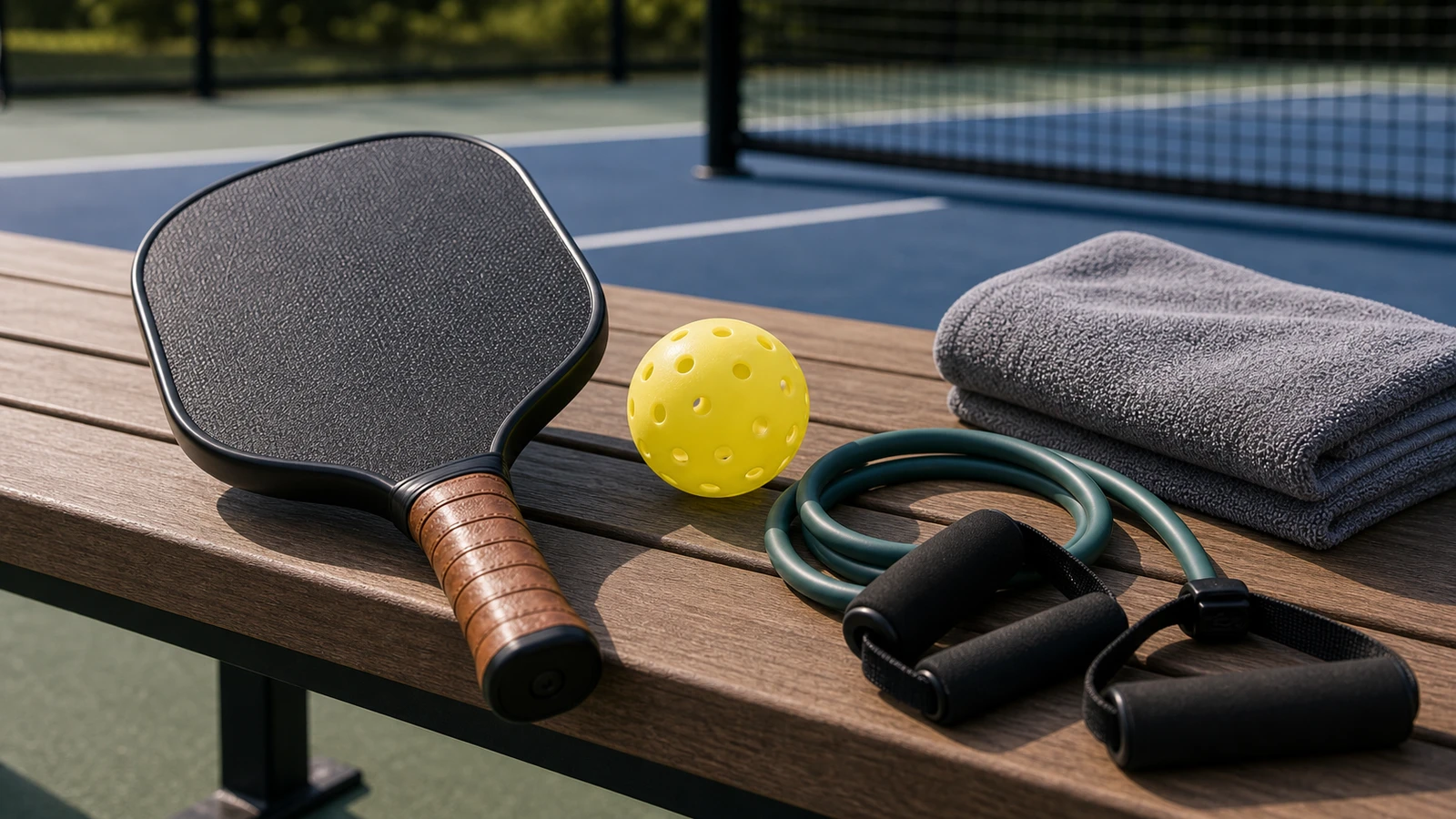
5. Finger extensions with rubber band
Tennis elbow rehabilitation protocols increasingly include finger extensor work because the extensor muscles of the fingers share tendons and connective tissue with the wrist extensors.
Setup: Wrap a thick rubber band around all five fingertips of your playing hand, fingers bunched together.
Movement:
- Slowly spread your fingers apart against the resistance of the band.
- Hold 2 seconds at full spread.
- Slowly close.
Reps: 3 sets of 15–20. Progression: thicker rubber bands once the current resistance feels trivial.
Technique fixes that prevent elbow pain more than any exercise
The exercises above build tendon capacity. But if your technique is recreating the injury every game, no amount of rehab keeps up. Three technique fixes eliminate the majority of recreational pickleball elbow cases.
Loosen your grip. Most recreational players grip the paddle with 5–7/10 tension when 3–4/10 is optimal. Tight grip → rigid wrist → every impact transmits straight into the lateral epicondyle. Drill this: play an entire rec session consciously holding the paddle as loose as you can while still not dropping it. It feels weird for two days, then it feels normal.
Drive the shot from your core, not your forearm. Power in pickleball should come from your abs, hips, and quads rotating through the shot — your forearm is the delivery mechanism, not the engine. If your forearm is doing the work, it’s the one getting overloaded.
Keep your wrist neutral on contact. A flicked or rolled wrist on the forehand or drive is the biomechanical equivalent of loading your elbow tendons directly. Your wrist should stay relatively neutral; the spin and angle come from paddle-face orientation and swing path, not wrist motion.
Equipment changes that help
| Change | Why it helps |
|---|---|
| Paddle weight 7.3–8.0 oz | Below 7.3 requires more arm muscle to swing; above 8.0 increases impact transmission |
| Grip size sized correctly | Too small forces you to grip harder; too large limits control → harder grip to compensate |
| Polymer honeycomb core over thermoformed | Softer impact, less vibration into the elbow |
| Thicker core (16mm+) | Longer dwell time = less sharp impact |
| Replace worn grip tape | Slippery grip makes you squeeze harder |
| Counterforce strap (brace) | Redistributes load off the tendon during activity |
If you’re shopping, our best paddles for seniors list includes specific picks engineered for vibration dampening — the ProKennex Ovation Pro in particular has lab-measured reduction in transmitted impact.
Warm-up routine before you play
5 minutes, done every session without exception:
- Arm circles — 20 forward, 20 backward
- Wrist circles — 15 each direction
- Wrist extensor stretch — 30 seconds each arm
- Wrist flexor stretch — 30 seconds each arm
- Shadow swings — 20 full-motion forehands and backhands without a paddle, easy pace
- Light dinks — 2–3 minutes of soft dinking at the kitchen line to warm up the joint before adding pace
Most pickleball elbow cases we’ve talked to started with a player skipping warm-up during a morning cold weather rec session. The cost of the 5 minutes is trivial compared to 6 weeks on the sideline.
When to stop playing and see a doctor
Stop playing immediately and book an appointment with a sports-medicine physician or orthopedist if any of these apply:
- Pain persists for more than 5 days after rest
- Pain radiates down your forearm or into your hand
- You feel numbness or tingling in your fingers
- Grip strength noticeably weakens (can’t open jars, drops objects)
- Pain wakes you up at night
- Swelling or visible bruising around the elbow
These are signs that you’re past the preventable stage. Continued play will make it significantly worse, and the recovery timeline stretches from weeks to months.
Frequently asked questions
- How long does pickleball elbow take to heal?
- With rest and the right rehab, early-stage cases typically resolve in 4–6 weeks. Chronic cases (more than 3 months of symptoms) can take 6 months or longer. Severe cases with confirmed tendon degeneration on imaging sometimes need platelet-rich plasma injections or, rarely, surgery.
- Can I play pickleball with a counterforce strap or elbow brace?
- Counterforce straps (the thin band just below the elbow on the forearm) can reduce load on the lateral epicondyle tendons during play and are generally safe to use. They're a complement to rest and rehab, not a replacement. Don't use them as a way to keep playing through ignored pain.
- What's the difference between pickleball elbow and tennis elbow?
- They're the same condition — lateral epicondylitis. The name is cosmetic. Some sources note that pickleball's higher rate of repetitive fine-motor wrist action (dinks, drops) may accelerate the condition faster than tennis for some players, but the anatomy and treatment are identical.
- Do compression sleeves prevent pickleball elbow?
- Compression sleeves can reduce perceived soreness and improve blood flow, but they're not evidence-backed as a prevention tool the way exercises and technique changes are. They don't hurt; they shouldn't replace the work above.
- How much pickleball is too much if I've had elbow issues before?
- The inflection point varies, but most sports-medicine practitioners recommend limiting total racquet-sport volume to 6 hours per week for players with prior tennis elbow history, with at least one full day off between sessions. Add workload slowly (10% per week) if you want to increase.
- Does a lighter paddle help with elbow pain?
- Usually yes, within limits. Dropping from 8.3 oz to 7.5 oz reduces swing momentum and reduces impact transmission. Going too light (under 7.0 oz) can backfire — you swing harder to compensate for lost momentum, and the harder swing reloads the elbow. The sweet spot is 7.3–7.8 oz for most players.
Sources
- Harvard Health: How to avoid this common pickleball injury
- Houston Methodist: How to Prevent Tennis Elbow When You Play Pickleball
- FLiK Pickleball: 5 Exercises for Recovery
- The Dink: Pickleball Elbow Expert Guide
- Scottsdale PT Performance: Injury Prevention Exercises
- Related: Best Paddles for Seniors · Best Paddle for Tennis Players
Not medical advice. Last updated April 26, 2026.
The Signal Brief
One useful dispatch each week.
One sharp take, three things worth reading, and the week's buying signals.